

JEE Chapter-wise Weightage for 2026: A Strategic Approach to Smart Preparation
The Joint Entrance Examination (JEE) is one of the most competitive engineering entrance exams in India. Every year, lakhs of students appear for JEE Main and JEE Advanced with the goal of securing a seat in top engineering institutes like the IITs, NITs, and IIITs.
With a vast syllabus spanning Physics, Chemistry, and Mathematics from both Class 11 and 12, it becomes essential for aspirants to take a strategic approach to preparation. Understanding chapter-wise weightage allows students to focus on high-scoring areas, manage time efficiently, and improve overall performance.
Why Chapter-wise Weightage is Important
- Prioritizes High-Yield Chapters: Focus on chapters that contribute more questions in the exam.
- Improves Time Management: Helps allocate study hours more effectively.
- Supports Revision Planning: Ensures important topics are revised multiple times.
- Enhances Scoring Potential: Maximizes output with minimal time by targeting frequent topics.
JEE Main 2026: Expected Chapter-wise Weightage (Based on Past Trends)
The following data is derived from analysis of JEE Main papers from 2020 to 2024. While NTA does not officially release chapter-wise weightage, this trend-based breakdown is widely used by coaching institutes for preparation strategy.
Physics – 30 Questions (100 Marks)
Class 11 Topics
| Chapter | Approx. Questions |
| Kinematics | 2–3 |
| Laws of Motion | 2 |
| Work, Energy and Power | 2–3 |
| Rotational Motion | 1–2 |
| Thermodynamics | 2–3 |
| SHM and Waves | 2 |
Class 12 Topics
| Chapter | Approx. Questions |
| Electrostatics | 2 |
| Current Electricity | 2–3 |
| Magnetism and EMI | 2–3 |
| Optics | 3–4 |
| Modern Physics (Atoms, Nuclei) | 3–4 |
| Semiconductor & Communication | 1–2 |
High-Weightage Topics: Optics, Modern Physics, Current Electricity, Thermodynamics
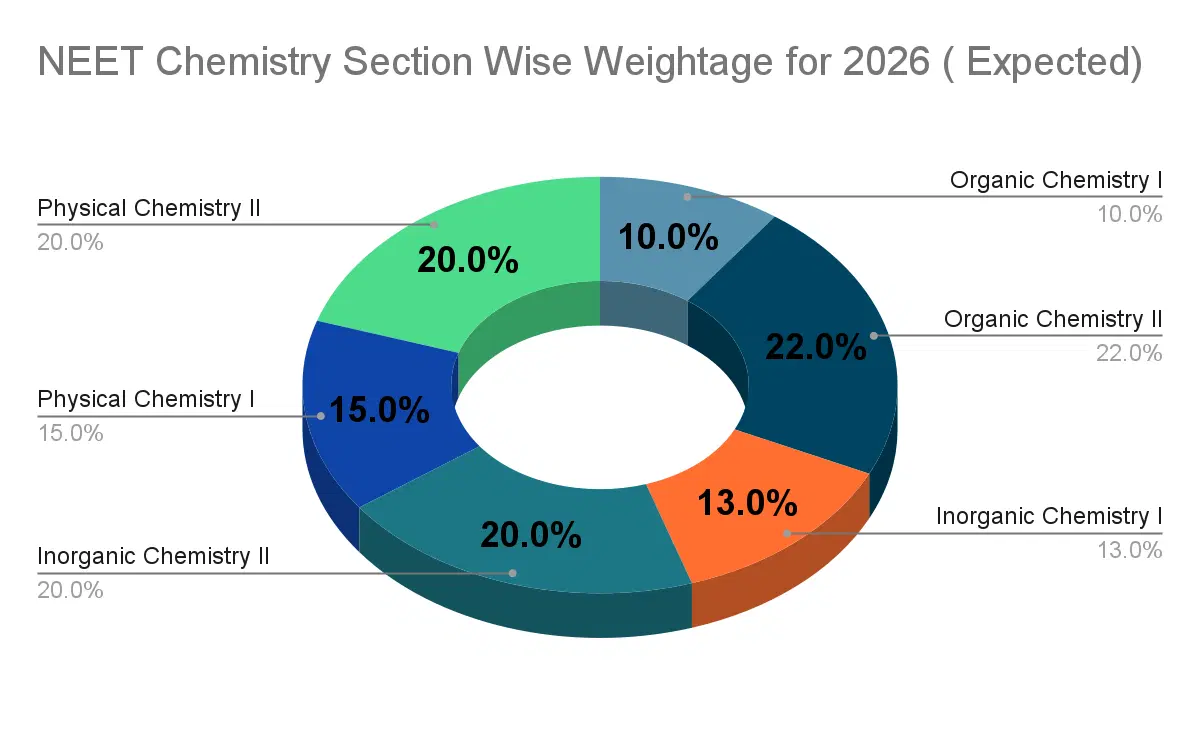
Chemistry – 30 Questions (100 Marks)
Class 11 Topics
| Chapter | Approx. Questions |
| Basic Concepts of Chemistry | 2 |
| Atomic Structure | 2 |
| Chemical Bonding | 2–3 |
| States of Matter & Thermodynamics | 2–3 |
| Equilibrium | 2 |
| Hydrocarbons | 2–3 |
Class 12 Topics
| Chapter | Approx. Questions |
| Solid State & Solutions | 2–3 |
| Electrochemistry | 2 |
| Chemical Kinetics | 2 |
| Coordination Compounds | 2–3 |
| Organic Chemistry (Class 12) | 4–5 |
| Biomolecules, Polymers | 2 |
High-Weightage Topics: Organic Chemistry, Coordination Compounds, Chemical Bonding, Electrochemistry
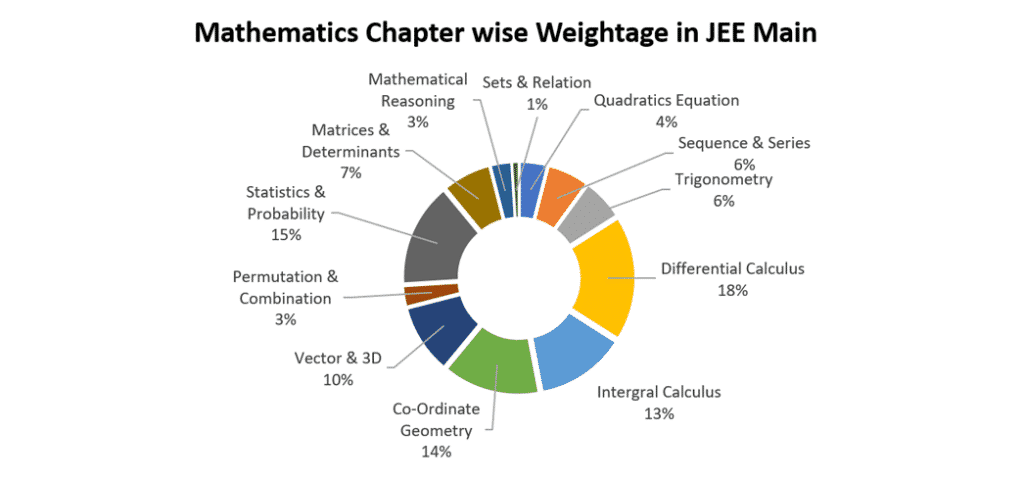
Mathematics – 30 Questions (100 Marks)
Class 11 Topics
| Chapter | Approx. Questions |
| Sets, Relations and Functions | 1–2 |
| Trigonometry | 2–3 |
| Permutations & Combinations | 2 |
| Binomial Theorem | 1 |
| Sequences and Series | 1–2 |
| Straight Lines & Conic Sections | 2–3 |
Class 12 Topics
| Chapter | Approx. Questions |
| Matrices and Determinants | 2–3 |
| Limits, Continuity & Differentiability | 2–3 |
| Application of Derivatives | 2–3 |
| Integrals and Area | 3–4 |
| Differential Equations | 2 |
| Probability & Statistics | 2 |
| Vectors and 3D Geometry | 3–4 |
High-Weightage Topics: Calculus (especially Integration and AOD), Vectors and 3D Geometry, Matrices, Probability
Strategic Preparation Tips
- Focus on Scoring Chapters First
Begin your preparation with chapters that are frequently tested and relatively easier to master, such as Modern Physics or Matrices. - Don’t Ignore Low-Weight Chapters Entirely
Even chapters with fewer questions can be decisive in tie-breaking. A single question can make a big difference in percentile rankings. - Master NCERT First, Then Advance
For Chemistry especially, NCERT books should be your base. Once mastered, move to advanced problems from reference books. - Practice Chapter-wise PYQs
Solve previous years’ questions chapter-wise to understand the pattern and depth of questions. - Time Your Practice
JEE is as much about accuracy as it is about speed. Time-bound practice tests help improve speed and reduce silly mistakes. - Regular Mock Tests and Analysis
Take full-length tests and spend time analyzing which chapters are consistently strong or weak for you. Adjust your study plan accordingly.
Final Thoughts
Preparing for JEE 2026 requires more than just hard work—it demands smart planning and focused execution. Understanding the chapter-wise weightage is one of the most effective tools in a student’s arsenal to strategize preparation.
While the weightage can guide your priorities, make sure to maintain conceptual clarity across all subjects and cover the full syllabus, as JEE is known for being unpredictable. With disciplined effort, regular practice, and timely revision, aspirants can significantly enhance their chances of securing top ranks.
Stay updated with any official announcements from NTA or IITs, and make data-driven decisions throughout your JEE journey.